
Saturday, Nov. 21, 2026
The Newberry Library · Chicago
To be Native is to understand ourselves through land and our relationship to the land.
We carry that understanding from one generation to the next in our clan teachings and stories, in languages that shape how we understand the world, and in songs we pass from one voice to another. We live it in ceremony, in the foods we prepare and the medicines we gather, in the return of seasons and the movement of water, and in what plants and animals teach us about how to live. Across hundreds of Native nations, different homelands, different waters, different skies and different histories shape those teachings in countless ways. Land gives those teachings a place to live. It gives memory a landscape, knowledge a season, responsibility a direction. It is not simply where our lives unfold. It is part of how we understand who we are, where we belong, and who we are responsible to.
The outside world has long imagined us through land, too. In books and classrooms, films and museums, Native people appear beside rivers and forests, against prairie and mountain, our identities almost always bound to place. Sometimes those portrayals recognize something true. Sometimes they turn us into stereotype, the old “noble savage,” imagined as purer, wiser or more spiritual because of an invented closeness to nature, or leave us suspended in a past where we are easier to romanticize than to know. And yet, beneath centuries of mythmaking, something true refuses to disappear: even when America has misunderstood Native people, it has rarely been able to imagine us without the land.
For urban Native people, that truth carries a particular pain. Here in Chicago, interruption is not confined to history. It happens quietly between generations, when a child knows their nation but not their clan; when stories and teachings carried for generations arrive only in fragments, if they arrive at all; when culture becomes a destination, something we travel across the city to find in a gathering, a classroom or a borrowed space, rather than something that surrounds us as we move through the world.
This is what interruption looks like now—what should have been inheritance becomes recovery.
Interruption has shaped our history, but it is not the beginning of our story. Our relationship with the lands and waters of this region has no founding date. It reaches back before colonial maps overwrote the names our ancestors knew, before borders divided homelands, beyond any calendar that could mark its beginning.
As Chicago and communities across the United States mark the nation’s 250th birthday, a deeper truth comes into focus: history and relationship do not keep the same time.
Two hundred and fifty years can hold the entire history of a nation. In our relationship with this land, two hundred and fifty years is a single heartbeat.
When we speak of Native futures, we are also asking about the futures that never had the chance to arrive.
Imagine five hundred years in which our languages simply kept growing in the voices of our children. Imagine ceremonies that never had to go underground, never had to be practiced in secret, never had to be pieced back together generations later. Imagine knowledge deepening because each generation could begin with what the generation before already knew, instead of searching for what had been forgotten or lost.
Interruption did more than take from what was. It interrupted what was yet to come.
We will never know the songs that were never sung, the ideas that never had time to take root, the knowledge that might have deepened, or the ways our cultures might have surprised us if each generation had been free to begin with the fullness of the one before it. There are things we lost that can be recovered. There are other things we will never know because interruption never gave them the chance to exist.
But our work cannot end with recovery. A living culture should not have to spend every generation rescuing itself.
What if the teachings our ancestors fought to keep alive were not only what survived the past, but the beginning of futures they never had the chance to see? What if the knowledge they entrusted to us could meet a world they could not have imagined and still remain unmistakably ours? What if our art, our ceremony, our foodways and our relationships with land could carry us into ways of being Native none of us can picture yet, shaped not only by memory, but by wonder and curiosity, by love and laughter, by joy and the audacity to dream beyond the world we inherited?
What if there were enough continuity to create without first having to recover, enough security to experiment and make mistakes, enough freedom to follow curiosity wherever it leads? Enough room to make beauty simply because there is beauty to make, to gather because there is something new to celebrate, and to imagine Native lives that do not yet have names.
What if our greatest responsibility as future ancestors is not to decide who they will become, but to give them the freedom to find out?
The choices we make now will become someone else’s inheritance. People we will never meet will one day stand where we are standing now, looking back at what we protected, what we restored, what we imagined and what we made possible.
So what if we leave them more than recovery? What if we leave them enough land, enough knowledge, enough relationship and enough freedom to dream beyond us? Enough to ask questions we cannot yet imagine, create things we cannot yet see, and become Native people in ways that are entirely their own?
The evening begins at 5:45 p.m. with cocktails, conversation and a Native art pop-up before guests gather for an exceptional Indigenous dining experience.
Menominee · Le Cordon Bleu-trained · Owner of Ketapanen Kitchen · Featured on Food Network’s Chopped
We will honor Robin Wall Kimmerer, who will join us virtually and share remarks, and Adam Kessel, who will receive his award in person.
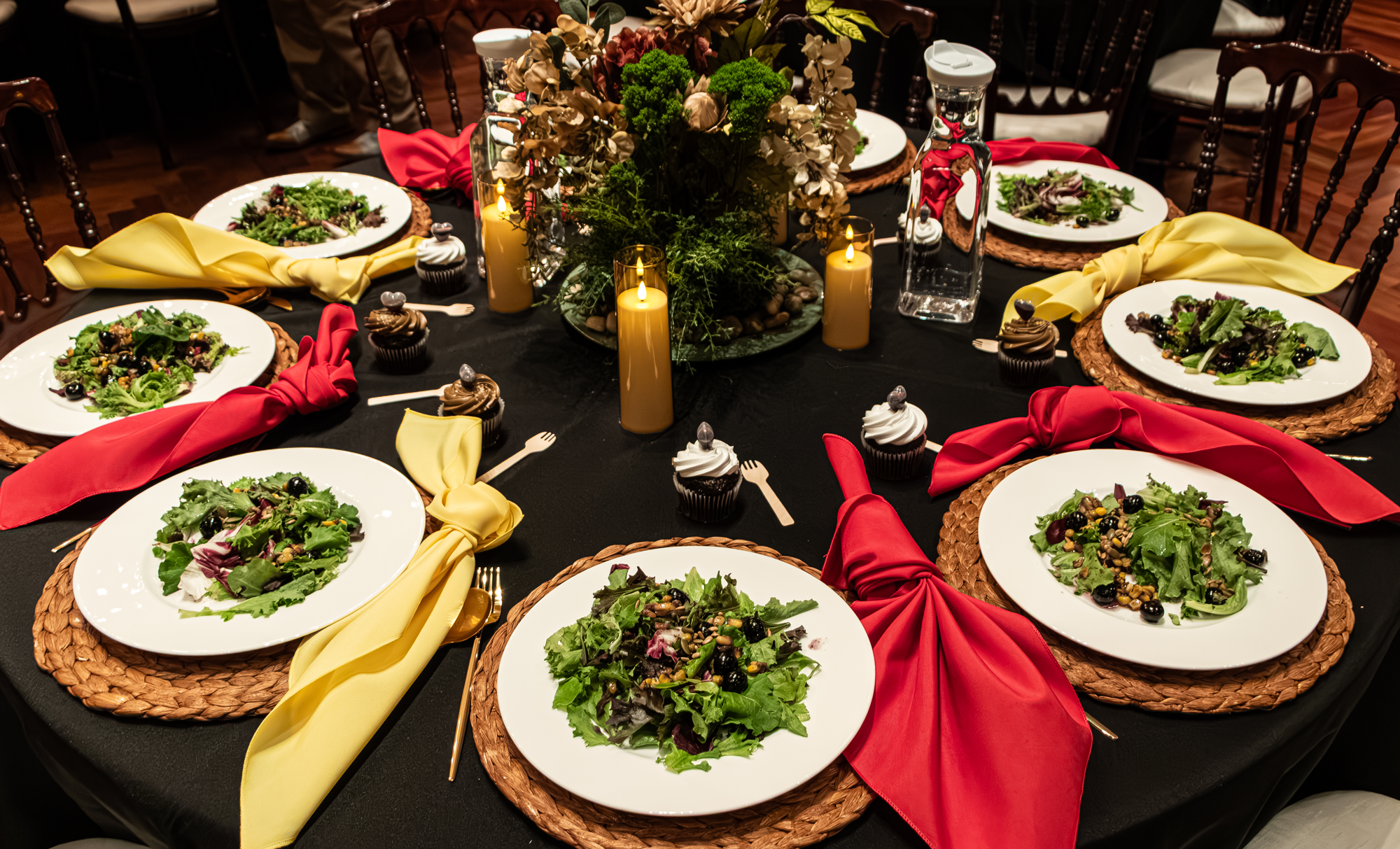
A scene from AIC’s 2025 gala at the Newberry Library.
Saturday, Nov. 21, 2026
5:45–9:30 p.m.
The Newberry Library
Chicago
$175 per guest
Cocktail attire encouraged, not required
Cocktails and conversation begin at 5:45 p.m., alongside the Native art pop-up and the opening of the silent auction.
The formal program opens with a drum and dance performance. Performers will be announced.
A seated meal rooted in Indigenous ingredients, foodways and relationships.
The silent auction, Native art pop-up and photo booth remain open for guests to enjoy.
Reserve your place for an unforgettable evening in support of Chicago’s Native community.
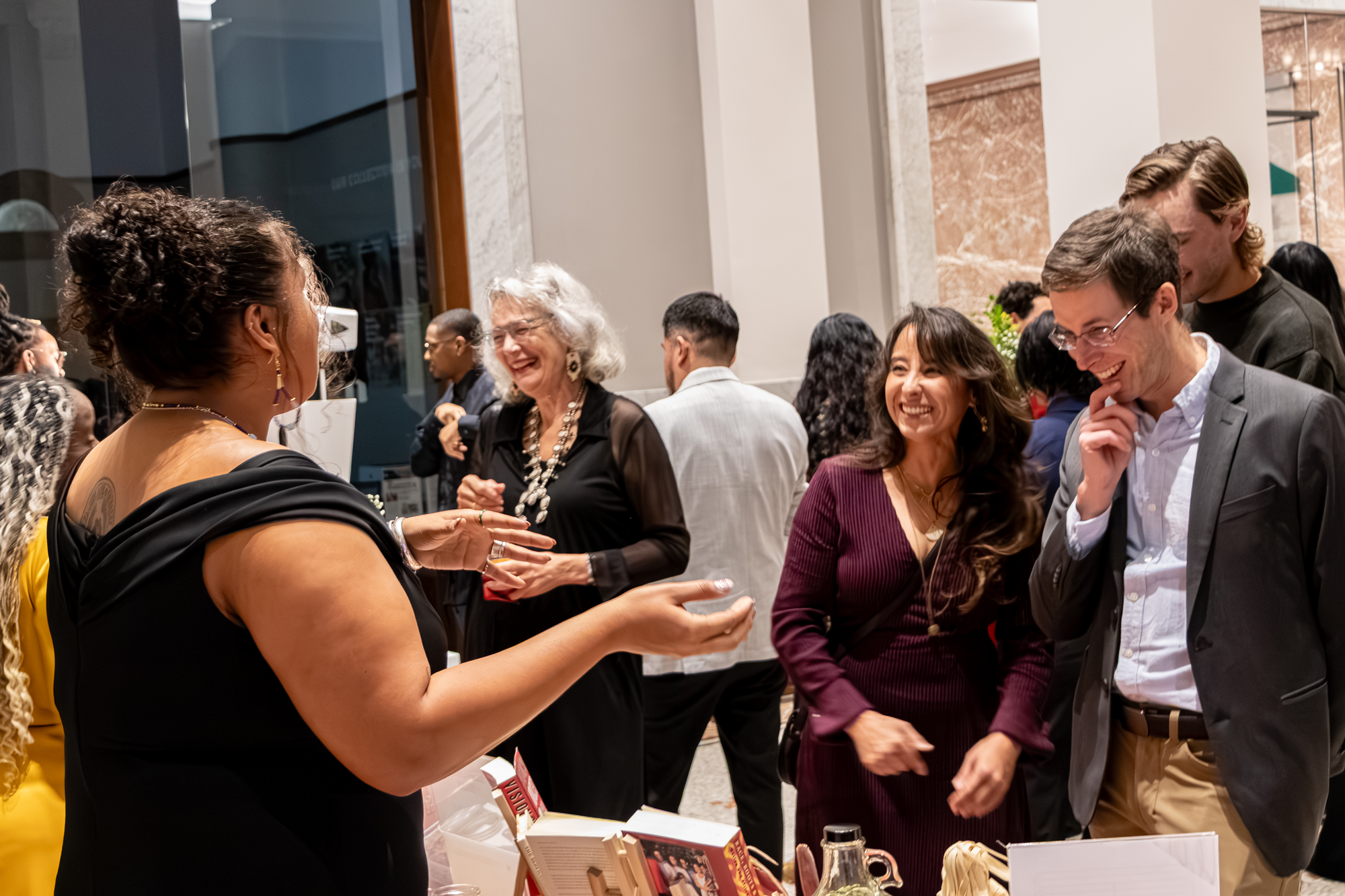
A moment from AIC’s 2025 gala.
One has transformed the national conversation about our responsibilities to the living world. The other has spent years putting those relationships into practice here in Chicago.
Together, their work gives form to Land Back, Life Forward.
Robin Wall Kimmerer is a mother, plant ecologist, writer and citizen of the Citizen Potawatomi Nation. She is the author of Braiding Sweetgrass, Gathering Moss and The Serviceberry, and the founding director of the Center for Native Peoples and the Environment at the SUNY College of Environmental Science and Forestry.
Through her teaching and writing, Kimmerer brings Indigenous knowledge and scientific inquiry into conversation, inviting people across the country to understand land not as property or scenery, but as a living relationship shaped by gratitude, reciprocity and responsibility.
Her work gives national language to the moral and imaginative work at the center of this gala: returning land while restoring the knowledge, kinship and possibility that allow Native futures to take shape.
Kimmerer will join us virtually to accept the award and offer remarks.
Adam Kessel is an educator, naturalist and author of Lakota, Italian and German ancestry. He serves as director of the Trailside Museum of Natural History and has deep roots at the American Indian Center, where he worked to create culturally grounded science education for Native youth and families.
At Trailside, Kessel helped establish a garden where sweetgrass and sage are grown for Native community use. Its first harvest was shared with the American Indian Center, American Indian Health Service of Chicago and the Center for Native American and Indigenous Research at Northwestern University. The garden makes ceremonial medicines more accessible while creating a place where their teachings and stories can be carried forward.
By helping Native families learn on the land, access medicines and continue cultural knowledge, he demonstrates what Life Forward requires: sustained relationships with land, community and future generations.
When the last guests step into the chilly November night, the tables are cleared, the room falls quiet and the lights go dark, the gala begins to recede into memory. As the evening ends, Land Back, Life Forward is just beginning.
The purpose of this night is not simply to celebrate what AIC has accomplished. It is to give this work the time, land and freedom to continue.
Repatriation names the act of return: ancestors and cultural belongings coming home, land restored to Native people. That return is necessary. At AIC, we use rematriation to speak to what the return begins—the renewal of relationships and responsibilities between Native people and Mother Earth, and the return of land to Native care, ceremony, knowledge and love.
Land is not simply something we possess. Land is relative and teacher. It carries water and medicines, food and memory, and responsibilities to those who came before us and those still to come. Returning land also means creating the conditions for those relationships to live and grow again.
In August 2026, AIC purchased 6.5 acres of prairie and oak savanna near Woodstock, bringing land into Native care and giving our community a place to build relationships on its own terms.
The land will become a place to restore habitat, gather seed, teach beside plants and water, and learn from the place itself. Its purchase is not the completion of the work. It gives that work somewhere to take root.
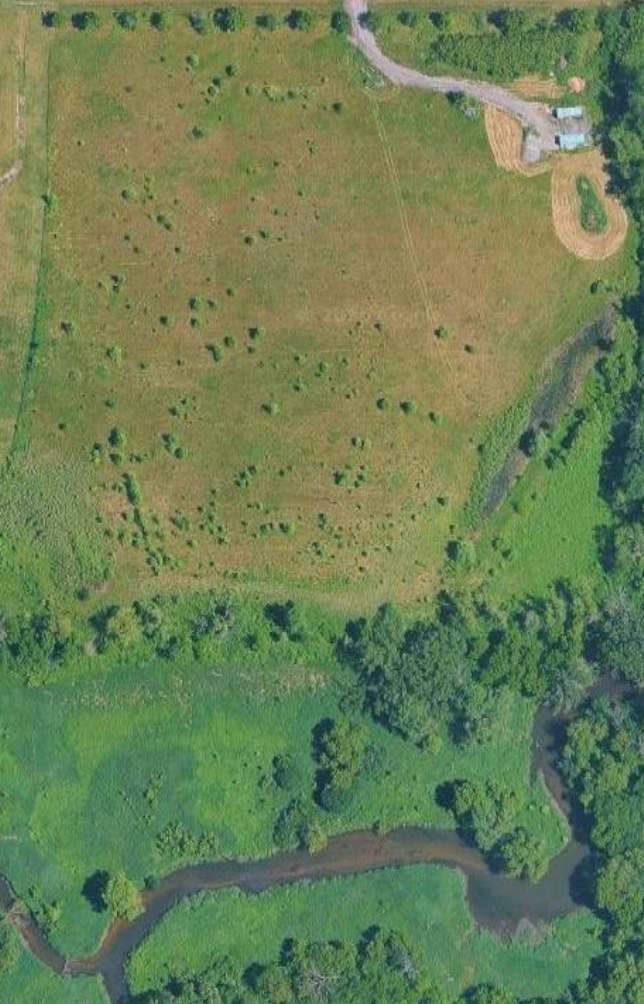
AIC’s newly acquired land along Nippersink Creek near Woodstock, Illinois. Aerial imagery: Google Maps.
Across AIC, rematriation moves through food, workshops and community gatherings. It is there in hands gathering seed, in people learning beside plants, in food moving into Native homes, in elders and families around shared tables, and in knowledge practiced together rather than held at a distance.
Knowledge was never meant to sit behind glass. It lives through use, memory and relationship—with the land, with our teachers and with one another.
AIC community members and families work together in the community garden.
Bison at Burlington Prairie in Kane County, Illinois.
In December 2025, bison stepped onto Burlington Prairie through a partnership between AIC, the Forest Preserve District of Kane County and Ruhter Bison LLC.
Their return is not spectacle. It is the renewal of a relationship—with land, education and responsibility. The first calf arrived in May 2026, carrying that relationship forward.
Rematriation asks us to look beyond the moment something comes home. What can live because it returned?
On land cared for over time, knowledge can move from hand to hand. Food can carry teachings into Native homes. Children can grow beside plants and bison as relatives, not abstractions. The generations who come after us can inherit relationships that no longer have to begin with recovery. This is rematriation taking form in real time.
Gather with us for an evening of Native food, art, music and movement; a silent auction; community honors; and a program rooted in the work AIC is carrying forward.
Reserved tables for eight are also available. AIC will contact table purchasers for guest names and entrée selections.
Saturday, Nov. 21, 2026
Cocktail hour begins at 5:45 p.m.
The evening concludes at 9:30 p.m.
The Newberry Library
60 W. Walton St. · Chicago
Cocktail hour and pop-up art gallery · Hosted bar · Seated dinner · Program and performances
A gala sponsorship makes the evening possible. It welcomes guests into a shared meal, brings Native art and storytelling into the room, honors people carrying this work forward and helps AIC gather our community in beauty.
But its reach does not end when the lights go dark. Sponsorship helps sustain the work the evening is built around: returning land to Native care, restoring relationships with bison and prairie, moving food into Native homes and carrying knowledge through practice, gathering and time together.
Each level includes recognition before, during and after the gala. View the sponsorship book for the complete benefits at every level, including seating, advertising, program recognition and visibility.
Presenting recognition · Premier placement · 11-seat table · One available
Prominent recognition · Preferred placement · 8-seat table
Featured recognition · Reserved placement · 8-seat table
Standard recognition · Reserved placement · 4 gala tickets
Standard recognition · Reserved placement · 2 gala tickets
Name recognition · Standard placement · 1 gala ticket
Questions about sponsorship or which opportunity is the right fit?
Contact Jay Young, AIC executive director, at jay.young@chicagoaic.org.
These opportunities offer focused visibility while directly supporting the people, places and programs that make rematriation possible.
Supports the shared meal that brings guests together around food and community.
Webpage listing and link · Dinner-area or table signage · Program recognition · Acknowledgment before dinner · Two tickets · Post-event thanks
Supports the opening cocktail reception before dinner and the formal program.
Webpage listing and link · Reception-area signage · Program recognition · Reception acknowledgment · Two tickets · Post-event thanks
Supports the Native art gallery pop-up during the reception.
Webpage listing and link · Gallery signage · Program recognition · Exhibit acknowledgment · Two tickets · Post-event thanks
Supports the short appeal video and storytelling segment.
Webpage listing and link · Logo with the video or story segment · Program recognition · Two tickets · Post-event thanks
Provides a reserved table for eight guests.
Table signage · Program listing · Webpage listing · Post-event thanks
Supports AIC’s land, food, community and Traditional Ecological Knowledge work.
Program listing · Webpage listing · Post-event thanks
Underwrites one community ticket.
Optional name listing in the program or post-event thank-you list
Everything you need before Nov. 21. We’ll update this section if any details change.
Still have a question? Contact AIC.
Saturday, Nov. 21, 2026, at The Newberry Library, 60 W. Walton St. in Chicago. Cocktail hour begins at 5:45 p.m., and the evening is expected to conclude at 9:30 p.m.
Each ticket includes the cocktail hour and pop-up art gallery, hosted bar, seated dinner, program and performances.
Cocktail attire is encouraged, but it is not required. Come dressed for a special evening in whatever allows you to feel comfortable and present.
Yes. Vegetarian and nonvegetarian entrée selections are available during registration. Please contact AIC before the gala regarding additional dietary needs.
Yes. Reserved tables for eight are available. AIC will contact the purchaser after registration to collect guest names and entrée selections.
The Newberry’s visitor lot is not available for event parking. The nearest garage is at 100 W. Chestnut St., with entry from Clark Street. The Newberry lists a discounted visitor rate of $9 for up to eight hours when guests scan the QR code at the security kiosk. The library is also near CTA Red and Brown Line stations and several bus routes. View current Newberry parking and transit information.
The silent auction will remain open throughout much of the evening. Bidding instructions and the closing time will be shared with guests at the gala.
The Newberry provides accessibility information for visitors. If you need an accommodation for the gala, please contact AIC before the event so we can help plan for your visit. View Newberry accessibility information.
We are grateful to the organizations whose support welcomes our community into this gathering—and helps carry AIC’s work beyond one night.

Saturday, Nov. 21, 2026 · The Newberry Library
© 2026 American Indian Center. All rights reserved.